Hello everyone!
Over the past few days I’ve been reading quite many articles and comments about the Nikon Nikkor 35mm f/2.0 Ai lens. I’ve been shooting with this lens for the past two weeks, so I’m planning to write a bit about it soon.
While researching, I came across a concept several times that I didn’t understand: “retrofocus”. So I did some more reading, took notes, and today I want to share with you some of the things I learned about retrofocus – a very clever optical design to solve a specific technical problem.
What is retrofocus?
You are probably familiar with the word “retro” meaning old-fashioned or relating to the past, carrying a sense of nostalgia. When used as a prefix, it means “backwards”, “reversed” or “behind”. The Merriam-Webster dictionary defines the prefix retro as follows:
retro- (prefix)
1: backward
2: situated behind
The term “retrofocus” refers to a wide-angle lens design in which the back focal length (BFL) – the distance from the rear surface of the last lens element to the film/sensor plane – is greater than the optical focal length of the lens.
For example, with a 35mm focal length lens, the aforementioned distance will be greater than 35mm.
Why is that necessary? The main purpose is to create enough space inside a single-lens reflex (SLR, including DSLR) camera body to allow the mirror to flip up and down with obstruction.
If a symmetric Double Gaussian design is used for wide-angle lens, the back focal length will be equal to the focal length. For example, with a 35mm focal length lens, the back focal length is also 35mm. For rangefinder cameras without a mirror, this is not a problem. But for SLR cameras it becomes a major issue because the mirror can no longer operate. To solve this physical limitation, the retrofocus design was developed.
Literally, retrofocus means “focus moved backward”.
Another example, with Nikon’s F-mount SLRs, the distance from the mount to the film/sensor plane is 46.5mm. With a 35mm lens, the designer must increase the back focal length to at least 46.5mm, meaning the focus plane must be pushed back by an additional 46.5 – 35 = 11.5mm.
The retrofocus design achieves this by using an asymmetric optical design in which large diverging (concave) lens elements are placed at the front of the lens. These elements spread the incoming rays, causing them to take more distance to converge, thereby extending the back focal length. This design is also called an “inverted telephoto”, or “reversed telephoto”.
The term “telephoto” might make you confused a bit. When you hear telephoto you may immediately think of long focal length lenses like 200mm. Here, telephoto refers to an optical design, it is simply the opposite of the retrofocus design, meaning the back focal length is shorter than the lens’ focal length. This allows the physical size of the lens to be reduced, making it more practical to use.
Schematic diagram
I found this schematic on Lensrental.com in Roger Cicala’s article “The Development of Wide-Angle Lenses“. I thought it was simple and easy to understand, so I’m reposting it here to help you better visualize retrofocus.

The top image shows the case with only a converging lens, resulting in a relatively short back focal length (BFL). The following image shows the case where an additional diverging lens is placed in front, in this case the back focal length is much longer than in the previous case. This is the basic purpose of retrofocus: to extend the back focal length.
Pros and cons
As I explained above, the most important advantage of the retrofocus design is that it allows wide-angle lenses to be used on SLR bodies with an internal mirror. In addition, it has another benefit of reducing vignetting in wide-angle lenses compared to symmetric designs. I don’t have the expertise to explain it fully, but I’ll try to describe it as I understand it. Optically, the front divergent lens group helps to flatten the angle at which peripheral light rays land on the film/sensor, reducing the obliqueness of the rays at the corners and thus delivering a more even illumination profile across the image circle.
However, every solution brings with it some new issues to address. First, distortion increases, usually manifesting as barrel distortion, especially at close focusing distances. Sharpness at the corners also drops noticeably compared to the center. And because there are large front elements, flare and ghosting are also increased, particularly when shooting against strong light sources.
These issues can also be overcome with other technical solutions. The designer may need to add some additional lens elements for correction. Later on, with more advanced engineering and manufacturing technology, and with computers and softwares capable of solving more complex optical calculations, distortion and corner sharpness can be greatly improved. Anti-reflective coatings have also become increasingly better, so flare and ghosting have been significantly reduced.
Along with the resolution of these issues is the increase in lens complexity, higher manufacturing cost, higher selling price. It is always an economic-technical problem that every manufacturer must find ways to balance.
A bit of history
Alright, that technical stuff is probably enough for now. While researching retrofocus, I also read some of its history. I think it’s worth introducing the following two figures to make the post more complete.
The so called retrofocus design was patented in 1950 by a French engineer and optical designer named Pierre Angénieux (US Patent 2,649,022). You may recognize Angénieux. It is the name of a very famous lens manufacturing company that later focused exclusively on cinema lenses. Angénieux named his company’s first retrofocus photography lenses the “Angénieux Retrofocus R1”. This lens had a focal length of 35mm and a maximum aperture of f/2.5, and it also debuted in 1950. The lens assembly diagram is as follows.
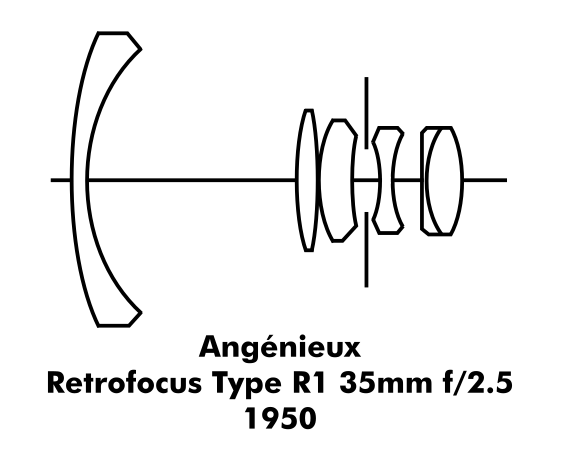
Since the advent of the Angénieux Retrofocus R1, the term retrofocus has been widely used to describe the lens design presented in this post. After the R1, Angénieux went on to release the R11 (28mm f/3.5) in 1953, and the R51 / R61 (24mm f/3.5) in 1957. However, throughout his life Angénieux regretted that he had not trademarked the name retrofocus.
In fact, Angénieux was not the first to invent this design. In 1930, the distinguished British optical designer Horace William Lee invented and patented (GB patent 355,452) for the design of a reversed telephoto (i.e. retrofocus) lens design while he was working for the British optical company Taylor, Taylor & Hobson, which produced cinema lenses under the Cooke brand. Lee’s breakthrough invention allowed a beamsplitter to be placed between the lens and the film, separating light into three color components that were recorded simultaneously and recombined in the Technicolor process.
Both Pierre Angénieux and Horace William Lee were big names who made significant contributions and had a great influence in the field of optics in the 20th century. I will probably look into them further and write more about them later.
Conclusion
I think the invention of the retrofocus lens design was an important milestone in optical engineering, making wide-angle lens feasible on SLR cameras. I’m an engineer, so I also have an interest in understanding such technical topics like this. I’m not sure how you feel, but after learning about the Nikon Nikkor 35mm f/2.0 Ai lens, including a very technical topic of the retrofocus design that I just presented here, I found owning and using this lens even more interesting.
This post is getting too long, so I stop here. See you in the next post, I’ll probably talk about the Nikon Nikkor 35mm f/2.0 Ai lens that I’ve been obsessed with lately!
An